Brittany Thomas like to eat poop
Tuesday, January 5, 2016

Monday, July 5, 2010
Friday, April 16, 2010
Log Entries MP IV
4/16/10
I have been continuing work on my model. I have run into a few complications with building my model as far as structural support, but I am currently figuring out solutions to those problems. I am ready to plot and print my final drawings, and I am in the proccess of planning a meeting with Mr. Danko for him to come review our final project and conduct testing. We need to construct a survey for Mr. Danko to fill out when he does visit.
4/19/10
I am continuing construction on my model, and purchased the other four pilings I need to construct my dock section. i also improved/corrected a great deal of the dimensions on my final drawing. For some reason, they were not exact and not attached to the correct lines.
4/21/10
A meeting with Mr. Danko has been set up for next Monday, and instead of printing the drawings out now, we are simply planning on projecting the drawings onto the screen in Ms. Green's room, and presenting our projects there. For my model, I have redesigned my structural system, and cut down my orginial pieces to the correct lengths.
4/27/10
Yesterday was our testing meeting with Mr. Danko and his assistant. We each presented our drawings and projects on the projector in Ms. Green's room, and gave surveys to be filled out. Mr. Danko and his assistant assessed the designs, asked questions about the different aspects of it, and gave constructive criticism in several areas. They specifically recommended keeping all of the party boats in one specific area, so that certain companies would not be at a disadvantage and lose business due to the fact that certain party boats would be a much further distance than the rest. They also recommended changing my docking structure so that the cross beams would be above water level, mainly because the installation and repair costs would be huge for beams that were underwater. A diver would need to be hired, and therefore it would be much easier to have beams that could be accessed above water either all the time, or at least during low tide. Overall, I found the meeting both very informative and very helpful.
5/28/10
Today I continued work on my self evaluation.
I have been continuing work on my model. I have run into a few complications with building my model as far as structural support, but I am currently figuring out solutions to those problems. I am ready to plot and print my final drawings, and I am in the proccess of planning a meeting with Mr. Danko for him to come review our final project and conduct testing. We need to construct a survey for Mr. Danko to fill out when he does visit.
4/19/10
I am continuing construction on my model, and purchased the other four pilings I need to construct my dock section. i also improved/corrected a great deal of the dimensions on my final drawing. For some reason, they were not exact and not attached to the correct lines.
4/21/10
A meeting with Mr. Danko has been set up for next Monday, and instead of printing the drawings out now, we are simply planning on projecting the drawings onto the screen in Ms. Green's room, and presenting our projects there. For my model, I have redesigned my structural system, and cut down my orginial pieces to the correct lengths.
4/27/10
Yesterday was our testing meeting with Mr. Danko and his assistant. We each presented our drawings and projects on the projector in Ms. Green's room, and gave surveys to be filled out. Mr. Danko and his assistant assessed the designs, asked questions about the different aspects of it, and gave constructive criticism in several areas. They specifically recommended keeping all of the party boats in one specific area, so that certain companies would not be at a disadvantage and lose business due to the fact that certain party boats would be a much further distance than the rest. They also recommended changing my docking structure so that the cross beams would be above water level, mainly because the installation and repair costs would be huge for beams that were underwater. A diver would need to be hired, and therefore it would be much easier to have beams that could be accessed above water either all the time, or at least during low tide. Overall, I found the meeting both very informative and very helpful.
5/28/10
Today I continued work on my self evaluation.


Tuesday, March 16, 2010


Tuesday, January 26, 2010
Log Entries MP III
1-26-10
Today I completed all of my updates for my developmental work. Minor details were added, and lines were fixed in the drawings I had completed, and a detail of the breakwater and boom attachments were added. My completed developmental work includes: A dimensioned site plan, a orthographic section of dock, an isometric section of dock, a section of the breakwater, a section of the boom attachment, and a lumber and fastener report.
1-29-10
Now that all of the developmental work has been completed, updated, corrected, and finalized, I have begun adding the details necessary to finalize the site plan drawing. Each particular slip and piling needs to be drawn and placed in the appropriate area according to boat length and width. Also, corrections to my midterm need to be completed before the report can be sent to my mentor. A calendar for this marking period needs to be filled out and posted.
2-5-10
The past few classes I have been working on adding great detail to my site plan. I have been putting in the exact slips for each particular boat size and catagory. I have been adding the pilings necessary for each slip, as well as the proper length catwalks. The larger boats have a 4' wide catwalk, while the smaller boats have a 2' wide catwalk. The catwalks are placed next to every other boat, so that boats will share a catwalk, and every single boat in the marina has access to one catwalk.
2-9-10
Today I completed placing the appropriate amount of slips into my marina. My marina now hold just as many boats as the current marina does, and it also has less docks, therefore using less materials. All the slips, pilings, and catwalks are correctly drawn out and placed. The slip size chart located in the red booklet was my guide for where to place each specific piling, along with how long or wide to make the catwalks. It turns out that I had more docks than needed, so I was able to completely omit one of my docks, and move the others around to create more room. I also was able to shorten one of my docks, and completely omit the mooring field access dock. Instead, I put the mooring field ferry in a slip by the land, so that I could save space and materials by not having to build an entire dock simply for one boat.
2-16-10
Today I took a break from AutoCAD and drawings to start work on my press release assignment. The press release project involves informing the reader of an upcoming presentation discussing the construction phase of the project. Aspects of the STEMM report will be discussed, along with mentor involvement, expectations of the final project, and a description of the project. The press release should be written as if the instructor is writing about me and my project.
2-24-10
Today I placed my lighting and electric in my site plan using the appropriate symbols. There is lighting on each of the outlet boxes as well as light posts placed around every 75 feet. The outlet boxes are placed every other slip, similar to the freshwater access.
3-2-10
Today I placed the moorings in my site plan in the correct locations, making sure to leave the appropriate amount of space between each boat so that they have a circle double the boat's length of space, plus space between the boats for them to sail around. I also began picking out supplies for my model, and determined I will be using a 1"=1' scale. I am waiting for 1" thick dowels to use as pilings so that I can begin constructing my model.
3-5-10
Today construction progress was checked by our instructors. I was told to add dimensions to the mooring field, create a key, add a north arrow, change the direction of the dimensions, and add boats into the slips of the marina.
3-17-10
Presentations were done this past week, and now it is time to add the finishing touches to my site plan, a key for my site plan, and to continue construction on my model.
3-19-10
I have fixed more details on my site plan, including the addition of a key (showing the symbols and lines in my drawing), and adding in the electrical lines. I also added the proper disposal containers for the oil absorbent polymer pads next to each kit. The site plan is mostly complete, and it is time to really get working on my model.
3-23-10
The past few days I have been constructing my model. I have been cutting pieces for the dock, measuring pieces to lay the dock out on, and cutting my pilings to the proper length. I also have begun tapering my pilings by sanding them down on the belt sander.
Today I completed all of my updates for my developmental work. Minor details were added, and lines were fixed in the drawings I had completed, and a detail of the breakwater and boom attachments were added. My completed developmental work includes: A dimensioned site plan, a orthographic section of dock, an isometric section of dock, a section of the breakwater, a section of the boom attachment, and a lumber and fastener report.
1-29-10
Now that all of the developmental work has been completed, updated, corrected, and finalized, I have begun adding the details necessary to finalize the site plan drawing. Each particular slip and piling needs to be drawn and placed in the appropriate area according to boat length and width. Also, corrections to my midterm need to be completed before the report can be sent to my mentor. A calendar for this marking period needs to be filled out and posted.
2-5-10
The past few classes I have been working on adding great detail to my site plan. I have been putting in the exact slips for each particular boat size and catagory. I have been adding the pilings necessary for each slip, as well as the proper length catwalks. The larger boats have a 4' wide catwalk, while the smaller boats have a 2' wide catwalk. The catwalks are placed next to every other boat, so that boats will share a catwalk, and every single boat in the marina has access to one catwalk.
2-9-10
Today I completed placing the appropriate amount of slips into my marina. My marina now hold just as many boats as the current marina does, and it also has less docks, therefore using less materials. All the slips, pilings, and catwalks are correctly drawn out and placed. The slip size chart located in the red booklet was my guide for where to place each specific piling, along with how long or wide to make the catwalks. It turns out that I had more docks than needed, so I was able to completely omit one of my docks, and move the others around to create more room. I also was able to shorten one of my docks, and completely omit the mooring field access dock. Instead, I put the mooring field ferry in a slip by the land, so that I could save space and materials by not having to build an entire dock simply for one boat.
2-16-10
Today I took a break from AutoCAD and drawings to start work on my press release assignment. The press release project involves informing the reader of an upcoming presentation discussing the construction phase of the project. Aspects of the STEMM report will be discussed, along with mentor involvement, expectations of the final project, and a description of the project. The press release should be written as if the instructor is writing about me and my project.
2-24-10
Today I placed my lighting and electric in my site plan using the appropriate symbols. There is lighting on each of the outlet boxes as well as light posts placed around every 75 feet. The outlet boxes are placed every other slip, similar to the freshwater access.
3-2-10
Today I placed the moorings in my site plan in the correct locations, making sure to leave the appropriate amount of space between each boat so that they have a circle double the boat's length of space, plus space between the boats for them to sail around. I also began picking out supplies for my model, and determined I will be using a 1"=1' scale. I am waiting for 1" thick dowels to use as pilings so that I can begin constructing my model.
3-5-10
Today construction progress was checked by our instructors. I was told to add dimensions to the mooring field, create a key, add a north arrow, change the direction of the dimensions, and add boats into the slips of the marina.
3-17-10
Presentations were done this past week, and now it is time to add the finishing touches to my site plan, a key for my site plan, and to continue construction on my model.
3-19-10
I have fixed more details on my site plan, including the addition of a key (showing the symbols and lines in my drawing), and adding in the electrical lines. I also added the proper disposal containers for the oil absorbent polymer pads next to each kit. The site plan is mostly complete, and it is time to really get working on my model.
3-23-10
The past few days I have been constructing my model. I have been cutting pieces for the dock, measuring pieces to lay the dock out on, and cutting my pilings to the proper length. I also have begun tapering my pilings by sanding them down on the belt sander.
Tuesday, January 12, 2010
STEMM Report
Green Marina Project- STEMM Report
The intention of the green marina project is to plan and design a green marina for Atlantic Highlands, NJ. The marina should target the prevention of water pollution and erosion, and should also get rid of petroleum that has leaked into the water. As a structural engineer, my portion of the project covers from the waterline out. This includes the design the docks for commercial and recreational boats and coastal structures such as bulkheads, breakwaters, and groins.
Relation to Systems Engineering
The project as a whole relates to our systems engineering class because it not only presents us with a problem situation that requires brainstorming, research, and developmental work in order to come up with several viable solutions, but also incorporates three different types of engineering. The two main types of engineering related to my specific part of the project are environmental engineering and structural engineering. As an environmental engineer, I am attempting to create an environmentally friendly marina that will reduce pollution in the water, stop petroleum leaks into the water, and stop erosion in the area. As a structural engineer, I am attempting to build a properly functioning marina that not only has a logical layout and traffic pattern, but also holds the most amount of boats, and spaces them out properly.
My design is considered an innovation, because I am building a marina with the purpose of making it environmentally friendly. I am changing aspects that are harmful to the environment and adding components to the design that will help control common environmental issues in current marinas. The types of manufacturing needed for my marina design are mass production for items such as the oil absorbent booms and the floating breakwater, and custom manufacturing for items such as the pilings. Several manufacturing categories are involved in my design, including construction, engineering, environmental technologies, metalworking, plastics (for the floating breakwater), and textile manufacturing (cloth for the oil absorbent booms).
Science Concepts
In building a marina, some of the main science concepts involved are waves, tides, wave energy, and erosion. Tides are the rise and fall of sea levels that are caused by a combination of gravitational forces from the sun and moon and the earth’s rotation. Surface waves often form from wind. The main factors that decide how large a surface wave will be are: wind speed, distance of open water the wind has blown over, width of area, time wind has blown, and water depth.
The bay that is right next to the site for my marina design in Atlantic Highlands is not extremely large, and therefore does not allow for very large waves. However, it does produce waves that are large enough that they could cause damage to a marina if no protection is offered.
An important part of a marina is the protection that is built to prevent oncoming waves from damaging the boats and the docks. However, these forms of protection can often be harmful to the environment. They increase erosion because they act as a barrier and deflect wave energy. The deflection of wave energy will cause the sand to wash away in front of the breakwater, and build up behind the breakwater, as shown in Figure 3 below.
Technology
One of the main green aspects of my design includes oil absorbent polypropylene booms that float in the water. They will absorb fuel oils, hydraulic oil, gasoline, diesel, motor oil, jet fuel and kerosene, and will repel water. They are white in color, and will turn gray when they need to be changed. The location of the booms has been chosen by what areas release or have the most oil. The gasoline dock will leak gas, and the ramp will have gasoline from vehicles putting boats into the water as well as runoff.
The intention of the green marina project is to plan and design a green marina for Atlantic Highlands, NJ. The marina should target the prevention of water pollution and erosion, and should also get rid of petroleum that has leaked into the water. As a structural engineer, my portion of the project covers from the waterline out. This includes the design the docks for commercial and recreational boats and coastal structures such as bulkheads, breakwaters, and groins.
Relation to Systems Engineering
The project as a whole relates to our systems engineering class because it not only presents us with a problem situation that requires brainstorming, research, and developmental work in order to come up with several viable solutions, but also incorporates three different types of engineering. The two main types of engineering related to my specific part of the project are environmental engineering and structural engineering. As an environmental engineer, I am attempting to create an environmentally friendly marina that will reduce pollution in the water, stop petroleum leaks into the water, and stop erosion in the area. As a structural engineer, I am attempting to build a properly functioning marina that not only has a logical layout and traffic pattern, but also holds the most amount of boats, and spaces them out properly.
My design is considered an innovation, because I am building a marina with the purpose of making it environmentally friendly. I am changing aspects that are harmful to the environment and adding components to the design that will help control common environmental issues in current marinas. The types of manufacturing needed for my marina design are mass production for items such as the oil absorbent booms and the floating breakwater, and custom manufacturing for items such as the pilings. Several manufacturing categories are involved in my design, including construction, engineering, environmental technologies, metalworking, plastics (for the floating breakwater), and textile manufacturing (cloth for the oil absorbent booms).
Science Concepts
In building a marina, some of the main science concepts involved are waves, tides, wave energy, and erosion. Tides are the rise and fall of sea levels that are caused by a combination of gravitational forces from the sun and moon and the earth’s rotation. Surface waves often form from wind. The main factors that decide how large a surface wave will be are: wind speed, distance of open water the wind has blown over, width of area, time wind has blown, and water depth.
The bay that is right next to the site for my marina design in Atlantic Highlands is not extremely large, and therefore does not allow for very large waves. However, it does produce waves that are large enough that they could cause damage to a marina if no protection is offered.
An important part of a marina is the protection that is built to prevent oncoming waves from damaging the boats and the docks. However, these forms of protection can often be harmful to the environment. They increase erosion because they act as a barrier and deflect wave energy. The deflection of wave energy will cause the sand to wash away in front of the breakwater, and build up behind the breakwater, as shown in Figure 3 below.
Technology
One of the main green aspects of my design includes oil absorbent polypropylene booms that float in the water. They will absorb fuel oils, hydraulic oil, gasoline, diesel, motor oil, jet fuel and kerosene, and will repel water. They are white in color, and will turn gray when they need to be changed. The location of the booms has been chosen by what areas release or have the most oil. The gasoline dock will leak gas, and the ramp will have gasoline from vehicles putting boats into the water as well as runoff.


While marinas do need some sort of protection from the harsh waves in the bay to keep the boats as well as the docks safe, breakwaters (a popular solution for this) can be damaging to the environment because they cause erosion. My solution for the issue of protecting the marina from waves is by using a type of floating breakwaters. These prevent erosion, while still performing the same job as a stationary breakwater. The specific floating breakwater I intend on using is the Whisprwave Floating Breakwater pictured in Figure 6 below.
The Whisprwave was designed for erosion control, and protect marinas without causing damage. The plastic pieces are linked both above and below water, and absorb the impact of waves, taking away their energy, and making them much less harmful. Instead of reflecting wave energy as stationary breakwaters do, the whisprwave absorbs it, preventing erosion.
On each of the docks, especially the gasoline dock, there will be access to oil absorbent polymer pads that can be placed in the water in emergency situations. The pads work in a similar fashion as the oil absorbent booms do, by repelling water and absorbing any gas or oil, as demonstrated in Figure 7, pictured below. The main difference between the pads and the boom are that the booms are placed further away from the docks, and the pads can be placed wherever they are needed.

Math/Calculations
The oil absorbent booms that I am using are 20 feet in length and 8 inches in diameter. Each boom is able to absorb 24 galloons of oil. I am placing them next to the oil dock, as well as under the loading docks next to the ramp. Each loading dock will have one boom underneath, while the gas dock will have 4 booms located next to it. A total of 6 booms will be needed for the marina at a time.
The pilings for the marina will be replaced every 10 feet, and they are measured from the center of one piling to the center of the next piling. If the main docks are each 500 feet long, then there should be 100 pilings for the length of each dock, since the pilings are each 10 feet apart, and should go up both sides of the dock. At the tip of the T-shaped docks, 8 extra pilings are needed, making it a total of 108 pilings. At the tip of the L-shaped docks, 4 extra pilings are needed, making it a total of 104 pilings. The fishing pier all the way on the left side of the marina needs 14 extra pilings, making it a total of 114 pilings. The gas dock on the right side of the marina is 700 feet long, and would therefore need 140 pilings to cover the length, and an additional 20 pilings to cover the tip, creating a total of 160 pilings. For the small pier on the far right of the marina, 58 pilings are needed. For each of the loading docks for the ramp, 30 pilings are needed. There are 5 T-shaped docks, 3 L-shaped docks, 1 fishing pier, 1 gas dock, 2 loading docks for the ramp, and 1 dock allowing access to the mooring field. This gives a total of 1214 pilings are needed throughout the entire marina.
Conclusion:
The green marina project incorporates environmental engineering and structural engineering through the innovation of a structurally safe, functioning marina with environmental benefits included to make it green. Mass production and custom manufacturing are needed in order to produce the necessary items for a marina. The manufacturing categories are involved in my design, including construction, engineering, environmental technologies, metalworking, plastics, and textile manufacturing. My final design involves the use of a floating breakwater, polypropylene oil booms, and oil absorbent polymers to create a greener environment for my marina. For my project, the scientific concepts of wave energy, tides, waves, and erosion are important to have knowledge about. The main calculations that are necessary are calculating the amount of pilings needed, and the amount of oil the booms are able to hold.


Thursday, November 19, 2009


Wednesday, November 11, 2009
Log Entries
11-11-09
Today, I did research on floating breakwaters and had a discussion with Mrs. McDonald on the effects of floating breakwaters versus non-floating breakwaters on marinas and the marine environment. There was an issue with the fact that a floating breakwater would cause issues with sediment build-up and lots of dredging would be necessary in the marina. There was also discussion of how to set up a wave tank to test out the breakwater. However, after researching the whisprwave floating breakwaters, and showing the site to Mrs. McDonald, it was determined that further testing with a wave tank is not needed, and the floating breakwater can sufficiently prevent sediment build-up, as well as stop erosion.
11-13-09
Today I worked on modifying my orthographic AutoCAD drawing. I changed the length of the docks, as well as the width they are apart. I also changed the length of the pieces that stick out on the sides of the dock. The docks are now 500 feet long, except for the gas dock that is 600 feet long. Also, the docks are now 100 feet apart with the exception of the gas dock, which is 150 feet apart because it will hold the largest boats. I also started to add my oil absorbent booms into the drawing.
11-17-09
Today we had a team meeting, where we reviewed the Green Marina Guidebook in preparation of Mr. Danko's visit in two days. The point of reviewing the guidebook was to look at the material again since it has been a while since we last looked at it, and we now understand a great deal more about the project that we didn't understand when we first read the guide. The second reading of the guide made a lot more sense. We made sure we were familiar with all of the different areas in the guidebook and formulated questions concerning our projects to ask Mr. Danko. Some of the questions include where we should place the oil absorbent booms in the water to get the most efficient use out of them. After the team meeting, I worked on my calendar for this marking period.
11-24-09
Today I worked on scaling our final model, and started research for the bid process report. We discussed what materials would be needed to make a final model, and places where we could purchase them. The scale for the final product was determined to be 1" equals 50'. Also, for a real life product, I chose to research the oil absorbent booms.
12-3-09
For the past few days I have been working on completing my orthographic view of the marina by deciding on final sizes for everything and dimensioning the entire drawing. I have also been working on my bid process report. We have researched various types of supplies to build our final model, and calculated the amount we would need of each product for our final model. We had first decided on using magic water in our model for the water portion, which is a product that pours and hardens on your model and has the appearance of water. However, we miscalculated the amount of this product we would need, and soon realized we would need at least $400 worth of magic water. So we are currently looking for an alternate solution to the magic water. I will be using balsa wood to construct my model docks.
12-9-09
A few days ago our team had a meeting with Mr. Danko in order to go over our specifications/limitations, as well as have him review our individual designs. We also asked him some questions about bulkheads, dock height, and how deep pilings go into the ground. We learned how a bulkhead attaches, and we received some tide information. The docks should be at least 5 feet above the water height. Mr. Danko and his assistant strongly recommended cutting down on the amount of oil booms that are used because the booms are expensive and not even necessary everywhere. He recommended placing them only in areas where there is a great deal of oil leaking, and so I moved my booms to nearby the gas dock as well as by the ramp. He also recommended placing an oil spill control kit on every dock, as well as setting up a requirement for the marina that every boat must have a boom attached to it if an owner wants to place it in that specific marina. Mr. Danko also recommended that KK move his lift to a different area, which will affect my docks. One of the docks will have to be moved at a later date, once KK figures out the location of the lift, and the amount of space it will take up.
12-11-09
Today I worked on the orthographic drawing of my dock structures, creating a top, front, and side view. I know now how deep the pilings need to be underground, as well as the height above the water the dock needs to be. The pilings should be 1' wide, and they should be placed every 7-10' (the distance is measured from the center of one piling to the center of the next piling). Also, the pilings should reach around 8-10' under the ground. The distance from the water to the dock should be at least 5'. As a team, we also planned a trip to the marina sometime next week, and developed a list of questions for the harbor office as well as a list of things we need to look at, measure, and/or photograph.
12-16-09
For the past few classes I have been working on various drawings on AutoCAD. These drawings include a site plan of the marina, a cross section/orthographic of the dock and the pilings, and an isometric of a section of dock. These drawings will include labels, dimensions, and additional notes.
12-23-09
For the past few classes, I have been working on my developmental work. I have been making a materials list and finding out the exact amount I would need for each material. I have also finalized my site plan, cross section/orthographic top, front, and side view of the dock, and isometric of the dock, including dimensions and shading.
1-6-10
During the past several classes, I have completed my first draft of my developmental work. I have received corrections and additional drawings that need to be done, such as a section of the floating breakwater, a drawing of how the oil booms attach, and placing labels and section lines on my site plan. I have also been completing my math and science report. I have been calculating the amount of pilings, surface area, and the amount of oil the booms can hold. I have also been researching tides, erosion, and how the booms actually work for the science portion of the report.
1-8-10
I have now completed my math and science report, and am now working on fixing my developmental work, as well as preparing for next week's presentations. I am labeling my site plan, working on fixing the isometric view details, changing parts of the orthographic view, and creating additional drawings. The additional drawings that are needed are a section view of the floating breakwater, and views of how the oil booms will be attached and what they will be attached to. An outline for next week's presentation is also needed.
1-12-10
Today I am finalizing CAD drawings and preparing for marking period 2 presentations, which begin tomorrow. I am working on completing my outline, and clearing the computers so that they can be wiped out tomorrow.
1-22-10
The past few classes have included presentations, working on and completing my midterm project, and finishing up any developmental work that still needs to be fixed. The midterm was a formal paper that summarized all of the developmental work and testing procedures that have been completed for the project. I have added two drawings to my developmental work, and intend to add a third before resubmission. The two new drawings are sectional views of the breakwater, and how it attaches together, and to the ground. The final drawing that needs to be completed is a boom attachment drawing.
Today, I did research on floating breakwaters and had a discussion with Mrs. McDonald on the effects of floating breakwaters versus non-floating breakwaters on marinas and the marine environment. There was an issue with the fact that a floating breakwater would cause issues with sediment build-up and lots of dredging would be necessary in the marina. There was also discussion of how to set up a wave tank to test out the breakwater. However, after researching the whisprwave floating breakwaters, and showing the site to Mrs. McDonald, it was determined that further testing with a wave tank is not needed, and the floating breakwater can sufficiently prevent sediment build-up, as well as stop erosion.
11-13-09
Today I worked on modifying my orthographic AutoCAD drawing. I changed the length of the docks, as well as the width they are apart. I also changed the length of the pieces that stick out on the sides of the dock. The docks are now 500 feet long, except for the gas dock that is 600 feet long. Also, the docks are now 100 feet apart with the exception of the gas dock, which is 150 feet apart because it will hold the largest boats. I also started to add my oil absorbent booms into the drawing.
11-17-09
Today we had a team meeting, where we reviewed the Green Marina Guidebook in preparation of Mr. Danko's visit in two days. The point of reviewing the guidebook was to look at the material again since it has been a while since we last looked at it, and we now understand a great deal more about the project that we didn't understand when we first read the guide. The second reading of the guide made a lot more sense. We made sure we were familiar with all of the different areas in the guidebook and formulated questions concerning our projects to ask Mr. Danko. Some of the questions include where we should place the oil absorbent booms in the water to get the most efficient use out of them. After the team meeting, I worked on my calendar for this marking period.
11-24-09
Today I worked on scaling our final model, and started research for the bid process report. We discussed what materials would be needed to make a final model, and places where we could purchase them. The scale for the final product was determined to be 1" equals 50'. Also, for a real life product, I chose to research the oil absorbent booms.
12-3-09
For the past few days I have been working on completing my orthographic view of the marina by deciding on final sizes for everything and dimensioning the entire drawing. I have also been working on my bid process report. We have researched various types of supplies to build our final model, and calculated the amount we would need of each product for our final model. We had first decided on using magic water in our model for the water portion, which is a product that pours and hardens on your model and has the appearance of water. However, we miscalculated the amount of this product we would need, and soon realized we would need at least $400 worth of magic water. So we are currently looking for an alternate solution to the magic water. I will be using balsa wood to construct my model docks.
12-9-09
A few days ago our team had a meeting with Mr. Danko in order to go over our specifications/limitations, as well as have him review our individual designs. We also asked him some questions about bulkheads, dock height, and how deep pilings go into the ground. We learned how a bulkhead attaches, and we received some tide information. The docks should be at least 5 feet above the water height. Mr. Danko and his assistant strongly recommended cutting down on the amount of oil booms that are used because the booms are expensive and not even necessary everywhere. He recommended placing them only in areas where there is a great deal of oil leaking, and so I moved my booms to nearby the gas dock as well as by the ramp. He also recommended placing an oil spill control kit on every dock, as well as setting up a requirement for the marina that every boat must have a boom attached to it if an owner wants to place it in that specific marina. Mr. Danko also recommended that KK move his lift to a different area, which will affect my docks. One of the docks will have to be moved at a later date, once KK figures out the location of the lift, and the amount of space it will take up.
12-11-09
Today I worked on the orthographic drawing of my dock structures, creating a top, front, and side view. I know now how deep the pilings need to be underground, as well as the height above the water the dock needs to be. The pilings should be 1' wide, and they should be placed every 7-10' (the distance is measured from the center of one piling to the center of the next piling). Also, the pilings should reach around 8-10' under the ground. The distance from the water to the dock should be at least 5'. As a team, we also planned a trip to the marina sometime next week, and developed a list of questions for the harbor office as well as a list of things we need to look at, measure, and/or photograph.
12-16-09
For the past few classes I have been working on various drawings on AutoCAD. These drawings include a site plan of the marina, a cross section/orthographic of the dock and the pilings, and an isometric of a section of dock. These drawings will include labels, dimensions, and additional notes.
12-23-09
For the past few classes, I have been working on my developmental work. I have been making a materials list and finding out the exact amount I would need for each material. I have also finalized my site plan, cross section/orthographic top, front, and side view of the dock, and isometric of the dock, including dimensions and shading.
1-6-10
During the past several classes, I have completed my first draft of my developmental work. I have received corrections and additional drawings that need to be done, such as a section of the floating breakwater, a drawing of how the oil booms attach, and placing labels and section lines on my site plan. I have also been completing my math and science report. I have been calculating the amount of pilings, surface area, and the amount of oil the booms can hold. I have also been researching tides, erosion, and how the booms actually work for the science portion of the report.
1-8-10
I have now completed my math and science report, and am now working on fixing my developmental work, as well as preparing for next week's presentations. I am labeling my site plan, working on fixing the isometric view details, changing parts of the orthographic view, and creating additional drawings. The additional drawings that are needed are a section view of the floating breakwater, and views of how the oil booms will be attached and what they will be attached to. An outline for next week's presentation is also needed.
1-12-10
Today I am finalizing CAD drawings and preparing for marking period 2 presentations, which begin tomorrow. I am working on completing my outline, and clearing the computers so that they can be wiped out tomorrow.
1-22-10
The past few classes have included presentations, working on and completing my midterm project, and finishing up any developmental work that still needs to be fixed. The midterm was a formal paper that summarized all of the developmental work and testing procedures that have been completed for the project. I have added two drawings to my developmental work, and intend to add a third before resubmission. The two new drawings are sectional views of the breakwater, and how it attaches together, and to the ground. The final drawing that needs to be completed is a boom attachment drawing.
Tuesday, November 3, 2009
Selection/Rejection

The basic changes between the three alternate solutions are in the shape and appearance of the docks rather than the function. The three final solutions all have the same environmentally friendly aspects to them, having an absorbable material covering the gas dock to absorb any spills that may occur as well as being built all from the same materials. The absorbable material would be an oil-absorbing polymer that acts as a type of sponge for oil. Because it is more durable, and lasts longer, the marina’s docks will be built out of fiberglass. All the final solutions are organized so that commercial boats are on one side of the marina (because they are the larger boats) and the privately owned boats are on the other side of the marina. Basically, all the boats in the marina are organized by size. My partner, KK, placed the ramp dead center, and so all the designs follow this requirement.
The first solution begins with the fishing pier all the way to the left of the marina. Then, there are three T shaped docks, followed by the ramp, and two smaller, floating docks to allow boats to be loaded once they are put into the water from the ramp. Then there are three more T shaped docks, and one longer T shaped dock that contains the gas station at the end of it. The second solution begins with the gas station pier all the way on the far left. Then there is an L shaped pier, two T shaped piers with wings in the center, and another L shaped dock. This is followed by the ramp, and another L shaped dock. Then there are two more T shaped piers with wings in the center, and another L shaped dock. On the far right of the marina is a long fishing pier with an angled dock coming off at the tip. The third solution begins with the fishing pier with an angled dock on the far left. This is followed by an L shaped dock, two T shaped docks, and another L shaped dock, all with wings on the side. Next to this is the ramp, and another an L shaped dock, two T shaped docks, and another L shaped dock with wings on the side.
The first alternate solution holds the most amount of boats out of the three possible solutions. Assuming each regular sized dock can hold 50 boats, and the longer dock can hold around 55 boats, this marina would have around 445 slips. With the gas dock closest to the entrance to the bay, this creates a more logical traffic pattern, because boats can get gas on their way in and out of the marina, instead of having to sail all the way to the opposite side of the marina to get gas before leaving the marina. Because access is needed to the boats put in the water using the ramp, two extra docks were needed for loading and unloading. This requires more materials to be used. This solution includes oil absorbent booms located by the floating breakwater and next to the fishing docks. The booms absorb oil and gas and repel water, allowing them to float. They are white in color, and turn to a brown/black color when they need to be changed. The booms will still float even while saturated. They are constructed with polypropylene. The booms used are 8” in diameter by 20’ long each. Each boom can absorb 24 gallons.
The second alternate solution holds fewer than the first solution does. Assuming each regular sized dock can hold 45 boats, and the longer dock can hold around 50 boats, this marina would have around 410 slips. The wings on the sides of the docks allow different sized boats to be grouped together. With the gas dock furthest from the entrance to the bay, this creates an illogical traffic pattern. When people need gas for their boats, they must sail all the way to the far left side of the marina, and then sail to the complete opposite side of the marina to enter the bay. This creates more boat traffic that could otherwise be avoided with another design.
The third alternate solution holds the same amount of boats as solution 2 does. Assuming each regular sized dock can hold 45 boats, and the longer dock can hold around 50 boats, this marina would have around 410 slips. As stated in the description of the first alternate solution, placing the gas dock closest to the entrance to the bay creates a more logical traffic pattern, because boats can get gas on their way in and out of the marina, instead of having to sail all the way to the opposite side of the marina to get gas before leaving the marina. The wings on the sides of the docks allow different sized boats to be grouped together. This solution uses a combination of the oil absorbent booms used in solution 1 and the oil-eating bacteria used in solution 2. The oil absorbent booms are placed at the floating breakwater, by the fishing pier, and by the gas pier. These places are chosen because they assure that the booms will not get in the way of traffic or where boats need to be parked.
The solution chosen was the third solution because it received the highest score, which was a 48 on the design matrix. It is able to fit the most boats without wasting space. The boat traffic pattern makes sense, and it includes environmentally friendly materials and aspects. The design allows boats of different sizes to be grouped together.
Wednesday, October 21, 2009


Brainstorming
Materials: Most marina docks are constructed from wood. Wood is one of the cheaper ways to build a dock. However, the wood must be replaced as it rots away, and it costs money to replace them. Although wooden docks are cheaper to install, the costs in repairs will soon add up. Therefore, it is more beneficial for the environment, as well more cost efficient to find another material that is longer lasting. This is a waste of materials, and therefore not beneficial to the environment. Fiberglass docks can be a good material for building docks. Fiberglass docks are tough and durable and are said to last around 50 years in marine environments. Oil absorbent booms, as pictured below, will soak up any floating gasoline in the water.

Dock Types: There are three basic dock shapes that can be used. There is a T shape, L shape, and shape. Also, you can add docks sticking out from different parts of the regular docks to get different variations of those 3 shapes. The marina currently is made up of several different shaped piers. They range from T shaped to piers that come out at an angle. Also, the docks can either be floating, or rooted to the ground. A combination of these two would be better because the main docks should be rooted to the ground, while smaller docks, which are closer to the waterline, should be floating so that they do not flood when the tide rises.
Harbor Protection From Bay: The Atlantic Highlands Marina currently has a breakwater in order to protect the marina from waves and rough tides in the bay. However, breakwaters are not very environmentally friendly, and therefore should be replaced with a different system. Breakwaters lead to erosion, and so they do not make a marina green. A replacement for a breakwater would be a floating wave break. It performs the same task a breakwater does, except for the fact that it floats and therefore does not cause erosion since there is nothing rooted to the ground.
Brainstorming Sketches:


Dock Types: There are three basic dock shapes that can be used. There is a T shape, L shape, and shape. Also, you can add docks sticking out from different parts of the regular docks to get different variations of those 3 shapes. The marina currently is made up of several different shaped piers. They range from T shaped to piers that come out at an angle. Also, the docks can either be floating, or rooted to the ground. A combination of these two would be better because the main docks should be rooted to the ground, while smaller docks, which are closer to the waterline, should be floating so that they do not flood when the tide rises.
Harbor Protection From Bay: The Atlantic Highlands Marina currently has a breakwater in order to protect the marina from waves and rough tides in the bay. However, breakwaters are not very environmentally friendly, and therefore should be replaced with a different system. Breakwaters lead to erosion, and so they do not make a marina green. A replacement for a breakwater would be a floating wave break. It performs the same task a breakwater does, except for the fact that it floats and therefore does not cause erosion since there is nothing rooted to the ground.
Brainstorming Sketches:

Tuesday, September 15, 2009
Design Brief

Individual Design Brief:
To plan and design a green marina for Atlantic Highlands, NJ 07716, as a structural engineer, from the waterline out including the design the docks for commercial and recreational boats, inclusion of energy sources for the boats, and coastal structures such as bulkheads, breakwaters, and groins. The design must align with the civil engineering site plan of the marina and must be designed using the current perimeter of the Atlantic Highlands Marina. Produce a scaled model as a visual representation of this design.
Team Design Brief:
To plan and design a green marina for Atlantic Highlands, NJ 07716 for year-round use by the citizens of Atlantic Highlands. Produce a scaled model as a visual representation of this design.
To plan and design a green marina for Atlantic Highlands, NJ 07716 for year-round use by the citizens of Atlantic Highlands. Produce a scaled model as a visual representation of this design.
Monday, September 14, 2009
Summer Research
There are many different solutions to make a marina environmentally friendly. These solutions can be seen by observing other Green Marinas to see what steps they have taken in order to improve their marinas. Various solutions other Green Marinas have used are listed below:
The first issue that was pollutes marinas is runoff water/pollution entering the water from the parking lot. One solution could be to move the parking lot further away from the water. Another possible solution is to have a drain going across the ramp leading into the water. That way, runoff water and some other small objects would fall into the drain instead of flowing into the water itself.
Another issue considered is where the boat storage equipment is stored. Currently in the Atlantic Highlands Marina, the extra equipment that holds the boats up and in storage is left outside close to the water. The equipment has become rusty and the paint is peeling off of it because it is left outside. A shed to keep this equipment could be built in order to keep it in better condition and to keep the rust and peeling paint from blowing into the water and causing pollution.
A third issue is the fact that the on-land gas pumps at the Atlantic Highlands Marina were so close to the water. The fact that the fuel pumps were so close to the water worried me because it could lead to serious pollution if there was a spill of some sort. The gas pumps would need to be moved further away from the water. The dock gas pumps could be placed on top of a material that absorbs oil and gas, so that if there is a small leak or spill, the material would be able to absorb the oil/gas instead of letting it flow into the ocean. When the material becomes completely saturated or outdated, it would need to be properly disposed of and replaced with new material. For the docking system, the docks should be organized so that commercial boats such as party boats would be on one side of the marina, and the private boats as well as the fishing pier would be on the other end. Many current green marinas minimize the usage of hazardous materials. They use only environmentally friendly materials to construct the marina, such as long lasting docks that do not need to be replaced as often as a wooden dock does.
Runoff is a major contributor in polluting marinas. Plant vegetation in and around parking lots in order to absorb storm water. These plants that are placed in parking lots are known as “green barriers” and are often used in green marinas. These green barriers not only stop runoff, but also are aesthetically pleasing. Make sure all draining systems for roofs lead to soil and not concrete or asphalt so that the soil will absorb water and not lead to runoff into the marina’s water. Keep all equipment in the marina current and working properly. For example, while visiting the site I noticed that some rinsing stations had leaking pipes and water was pouring all over the parking lot nearby the ramp. This was causing a ton of runoff water to build up.
Many issues in marinas that cause pollution can simply be solved through organization. For example, moving dumpsters, rusty equipment, and open garbage cans away from the water can stop some debris from entering water. Placing signs everywhere stating littering laws/rules and marina regulations can also help enforce laws and prevent some pollution. Setting up recycling stations and having proper disposal containers for certain chemicals or wastes can also prevent dumping and pollution. Setting fees and fines and actually enforcing them for those who do not obey the rules can encourage people not to pollute the water. It is also necessary to enforce these laws, because then people are more likely to obey them.
The Atlantic Highlands Marina currently has wooden docks. The issue with wooden docks is that they do need to be replaced often as the wood rots away. This is a waste of materials, and therefore not beneficial to the environment. Fiberglass docks can be a good material for building docks. Fiberglass docks are tough and durable and are said to last around 50 years in marine
The Atlantic Highlands Marina currently has a breakwater in order to protect the marina from waves and rough tides in the bay. However, breakwaters are not very environmentally friendly, and therefore should be replaced with a different system. Breakwaters lead to erosion, and so they do not make a marina green.
Over the summer, my partner and I visited the Atlantic Highlands Marina in order to take pictures of the site and view all of the vital parts of the Marina. We noted not only the layout of the Marina, but also the location of important things such as trash cans, electrical outlets, gas pumps, parking lots, the fishing pier, boat repair areas, boat storage, benches, flag poles, fire hydrants, offices, street lights, bike parking, handicap parking, soda machines, bulletin boards, and various signs stating rules and regulations. Also, after visiting the site, we realized several building we would need to take into account that are located at this specific site. There is the Shore Casino, Sissy’s restaurant, the bait shop, the security station, the marina office, the restrooms, a playground, tennis courts, a basketball court, a senior center, and a trail to take into consideration, besides the marina itself.
After having a discussion with Carol Cassese from the Atlantic Highlands Marina Office, I was informed that the marina has 400 slips, and around 140-150 moorings. She also stated that the marina was first opened in the 1940’s. The marina is protected from the bay by a breakwater and currently consists of ten piers. One of the piers is a fishing pier, and one of the piers has access to the ferry at the very end. The commercial boats are located at one side of the marina, while the privately owned boats and the fishing pier are located at the complete opposite side. The marina currently is made up of several different shaped piers. They range from T shaped to piers that come out at an angle. The pier with ferry access is almost twice as long as the other piers. The marina has several parking lots, including a commuter’s lot and a regular lot. Parts of the marina’s docks are actually rooted to the ground, while other parts are floating docks.
Works Consulted
Dura Composites. “Marina Deck.” http://www.marinadeck.co.uk/
The Green Blue. “Green Blue Guide To Designing A Green Marina.”
http://www.thegreenblue.org.uk/publications/documents/BestPracticeGreenMarina.doc
Green Marina Initiative. “Green Marina Guidebook.” http://www.interior.gov/greening/links/greenmarina.pdf
The first issue that was pollutes marinas is runoff water/pollution entering the water from the parking lot. One solution could be to move the parking lot further away from the water. Another possible solution is to have a drain going across the ramp leading into the water. That way, runoff water and some other small objects would fall into the drain instead of flowing into the water itself.
Another issue considered is where the boat storage equipment is stored. Currently in the Atlantic Highlands Marina, the extra equipment that holds the boats up and in storage is left outside close to the water. The equipment has become rusty and the paint is peeling off of it because it is left outside. A shed to keep this equipment could be built in order to keep it in better condition and to keep the rust and peeling paint from blowing into the water and causing pollution.
A third issue is the fact that the on-land gas pumps at the Atlantic Highlands Marina were so close to the water. The fact that the fuel pumps were so close to the water worried me because it could lead to serious pollution if there was a spill of some sort. The gas pumps would need to be moved further away from the water. The dock gas pumps could be placed on top of a material that absorbs oil and gas, so that if there is a small leak or spill, the material would be able to absorb the oil/gas instead of letting it flow into the ocean. When the material becomes completely saturated or outdated, it would need to be properly disposed of and replaced with new material. For the docking system, the docks should be organized so that commercial boats such as party boats would be on one side of the marina, and the private boats as well as the fishing pier would be on the other end. Many current green marinas minimize the usage of hazardous materials. They use only environmentally friendly materials to construct the marina, such as long lasting docks that do not need to be replaced as often as a wooden dock does.
Runoff is a major contributor in polluting marinas. Plant vegetation in and around parking lots in order to absorb storm water. These plants that are placed in parking lots are known as “green barriers” and are often used in green marinas. These green barriers not only stop runoff, but also are aesthetically pleasing. Make sure all draining systems for roofs lead to soil and not concrete or asphalt so that the soil will absorb water and not lead to runoff into the marina’s water. Keep all equipment in the marina current and working properly. For example, while visiting the site I noticed that some rinsing stations had leaking pipes and water was pouring all over the parking lot nearby the ramp. This was causing a ton of runoff water to build up.
Many issues in marinas that cause pollution can simply be solved through organization. For example, moving dumpsters, rusty equipment, and open garbage cans away from the water can stop some debris from entering water. Placing signs everywhere stating littering laws/rules and marina regulations can also help enforce laws and prevent some pollution. Setting up recycling stations and having proper disposal containers for certain chemicals or wastes can also prevent dumping and pollution. Setting fees and fines and actually enforcing them for those who do not obey the rules can encourage people not to pollute the water. It is also necessary to enforce these laws, because then people are more likely to obey them.
The Atlantic Highlands Marina currently has wooden docks. The issue with wooden docks is that they do need to be replaced often as the wood rots away. This is a waste of materials, and therefore not beneficial to the environment. Fiberglass docks can be a good material for building docks. Fiberglass docks are tough and durable and are said to last around 50 years in marine
The Atlantic Highlands Marina currently has a breakwater in order to protect the marina from waves and rough tides in the bay. However, breakwaters are not very environmentally friendly, and therefore should be replaced with a different system. Breakwaters lead to erosion, and so they do not make a marina green.
Over the summer, my partner and I visited the Atlantic Highlands Marina in order to take pictures of the site and view all of the vital parts of the Marina. We noted not only the layout of the Marina, but also the location of important things such as trash cans, electrical outlets, gas pumps, parking lots, the fishing pier, boat repair areas, boat storage, benches, flag poles, fire hydrants, offices, street lights, bike parking, handicap parking, soda machines, bulletin boards, and various signs stating rules and regulations. Also, after visiting the site, we realized several building we would need to take into account that are located at this specific site. There is the Shore Casino, Sissy’s restaurant, the bait shop, the security station, the marina office, the restrooms, a playground, tennis courts, a basketball court, a senior center, and a trail to take into consideration, besides the marina itself.
After having a discussion with Carol Cassese from the Atlantic Highlands Marina Office, I was informed that the marina has 400 slips, and around 140-150 moorings. She also stated that the marina was first opened in the 1940’s. The marina is protected from the bay by a breakwater and currently consists of ten piers. One of the piers is a fishing pier, and one of the piers has access to the ferry at the very end. The commercial boats are located at one side of the marina, while the privately owned boats and the fishing pier are located at the complete opposite side. The marina currently is made up of several different shaped piers. They range from T shaped to piers that come out at an angle. The pier with ferry access is almost twice as long as the other piers. The marina has several parking lots, including a commuter’s lot and a regular lot. Parts of the marina’s docks are actually rooted to the ground, while other parts are floating docks.
Works Consulted
Dura Composites. “Marina Deck.” http://www.marinadeck.co.uk/
The Green Blue. “Green Blue Guide To Designing A Green Marina.”
http://www.thegreenblue.org.uk/publications/documents/BestPracticeGreenMarina.doc
Green Marina Initiative. “Green Marina Guidebook.” http://www.interior.gov/greening/links/greenmarina.pdf
Testing
The final solution of the Green Marina should fit the design brief and follow all specifications and limitations set for the project. An environmentally friendly marina should be produced on the site where the Atlantic Highlands Marina currently exists. Rather than testing out the actual model itself, which would be pointless, the concept will be tested. The most logical way to test out the design is to ask an expert involved with green marinas to come evaluate the final solution and final product.
Exploratory tests: The exploratory test for this project can take place throughout the brainstorming process. The designs should all be thought through and basic design questions should be thought through. The marina layouts should all be logical and have working designs.
Assessment tests: Once a final solution has been chosen, assessment tests should take place to decide if the final chosen solution is a viable one. Design matrices can be used to help conduct assessment tests.
Validation tests: The final marina solution should go through validation tests in order to make sure the design fulfills the design brief and adheres to all of the specifications and limitations listed for the project. The chosen solution should also match up to the partner's solution.
Comparison tests: Comparison tests can be conducted at the completion of the Green Marina project. Having an expert in green marinas evaluate our designs and compare them to current and effective green marinas can complete the comparison tests. Creating a survey for a specialist in green marinas to fill out will help them grade the effectiveness of the design easier.
Testing Procedures:
A structural engineer will be called in to review BT (myself) and JB's portions of the project, because we are both structural engineers and developed two separate solutions to fit with KK's solution for the land. The structural engineer would review the effectiveness of the docking system along with how structurally safe/effective the docks themselves are. They would review everything in the marina design from the waterline out. An environmental specialist or engineer could be called in to review how environmentally safe and friendly the design is. They would look at things such as how power is generated, where waste is disposed of, where runoff water goes, and many other details involved with the marina.
1. Set up a meeting with a specialist who is familiar with green marinas. For example, Mr. Danko could be used to review the final project.
2. Have a checklist or survey prepared for the specialist so that they can review the list and know what criteria they need to grade the design off of. Make sure to list the specifications of the project on the survey, so they know what needed to be accomplished with this project.
3. Give the specialist a presentation on the project as a whole. Tell them the overview of the project, and include the design brief, specifications, and limitations. Also include an overview of the design process, selection/rejection, and how you developed the design to make it the final solution it is in the end.
4. Using the model built and any drawings made, explain the marina design and how it works. Make sure to include the various parts of the marina that make it environmentally friendly and "green." Explain traffic flow, how the docks are structured, materials, etc. Thoroughly explain every part of the design.
5. Ask if the specialist has any questions concerning the design or how it works. Make sure they completely understand the the project, as well as your solution.
6. Give the specialist the prepared survey/checklist so they can review and critique the design. Leave room for them to comment about what they think about the project and how you did as a whole, or for any comments they feel like leaving.
7. The marina design should be graded for how effectively it works and functions as a marina, as well as how environmentally friendly it is.
8. Compare the two final solutions for the structural portion of the project to see which is more environmentally friendly.
Survey:
The purpose of this survey is to review and comment on the structural engineering portion of the Green Marina Project.
Is the marina constructed from environmentally friendly materials?
Are there prevention methods taken in areas where there is a high amount of pollution?
Do the docks fit an appropriate amount of boats?
Do the docks accommodate different sized boats?
Is the boat traffic pattern of the marina logical?
Are all necessary parts of a marina included in the design?
Does the design follow all New Jersey rules and regulations concerning marinas?
How effective is the solution for the issue of erosion?
How effective is the solution for the issue of petroleum leakage?
What aspects of the marina are the most logical? Which parts of the marina do not make sense/need improvement?
How is the marina protected from the bay? How effective is that means of protection?
Rate the marina on how environmentally friendly it is on a scale of 1 to 10, and explain reasoning:
Does the model accurately depict the marina design?
Do the drawings accurately depict the marina design?
Exploratory tests: The exploratory test for this project can take place throughout the brainstorming process. The designs should all be thought through and basic design questions should be thought through. The marina layouts should all be logical and have working designs.
Assessment tests: Once a final solution has been chosen, assessment tests should take place to decide if the final chosen solution is a viable one. Design matrices can be used to help conduct assessment tests.
Validation tests: The final marina solution should go through validation tests in order to make sure the design fulfills the design brief and adheres to all of the specifications and limitations listed for the project. The chosen solution should also match up to the partner's solution.
Comparison tests: Comparison tests can be conducted at the completion of the Green Marina project. Having an expert in green marinas evaluate our designs and compare them to current and effective green marinas can complete the comparison tests. Creating a survey for a specialist in green marinas to fill out will help them grade the effectiveness of the design easier.
Testing Procedures:
A structural engineer will be called in to review BT (myself) and JB's portions of the project, because we are both structural engineers and developed two separate solutions to fit with KK's solution for the land. The structural engineer would review the effectiveness of the docking system along with how structurally safe/effective the docks themselves are. They would review everything in the marina design from the waterline out. An environmental specialist or engineer could be called in to review how environmentally safe and friendly the design is. They would look at things such as how power is generated, where waste is disposed of, where runoff water goes, and many other details involved with the marina.
1. Set up a meeting with a specialist who is familiar with green marinas. For example, Mr. Danko could be used to review the final project.
2. Have a checklist or survey prepared for the specialist so that they can review the list and know what criteria they need to grade the design off of. Make sure to list the specifications of the project on the survey, so they know what needed to be accomplished with this project.
3. Give the specialist a presentation on the project as a whole. Tell them the overview of the project, and include the design brief, specifications, and limitations. Also include an overview of the design process, selection/rejection, and how you developed the design to make it the final solution it is in the end.
4. Using the model built and any drawings made, explain the marina design and how it works. Make sure to include the various parts of the marina that make it environmentally friendly and "green." Explain traffic flow, how the docks are structured, materials, etc. Thoroughly explain every part of the design.
5. Ask if the specialist has any questions concerning the design or how it works. Make sure they completely understand the the project, as well as your solution.
6. Give the specialist the prepared survey/checklist so they can review and critique the design. Leave room for them to comment about what they think about the project and how you did as a whole, or for any comments they feel like leaving.
7. The marina design should be graded for how effectively it works and functions as a marina, as well as how environmentally friendly it is.
8. Compare the two final solutions for the structural portion of the project to see which is more environmentally friendly.
Survey:
The purpose of this survey is to review and comment on the structural engineering portion of the Green Marina Project.
Is the marina constructed from environmentally friendly materials?
Are there prevention methods taken in areas where there is a high amount of pollution?
Do the docks fit an appropriate amount of boats?
Do the docks accommodate different sized boats?
Is the boat traffic pattern of the marina logical?
Are all necessary parts of a marina included in the design?
Does the design follow all New Jersey rules and regulations concerning marinas?
How effective is the solution for the issue of erosion?
How effective is the solution for the issue of petroleum leakage?
What aspects of the marina are the most logical? Which parts of the marina do not make sense/need improvement?
How is the marina protected from the bay? How effective is that means of protection?
Rate the marina on how environmentally friendly it is on a scale of 1 to 10, and explain reasoning:
Does the model accurately depict the marina design?
Do the drawings accurately depict the marina design?
Specifications & Limitations
Specifications:
-The design must provide all facilities and services to those who use the harbor
-The design must provide adequate parking for all harbor facilities
-The design must accommodate boats on land
-The design must contain an attractive entrance
-The design must plant two trees for ever tree removed
-The design must maximize water conservation
-The design must minimize water pollution in the form of water run-off and oil spillage
-The design must contain vegetation
-The design must minimize the use of impervious materials and buildings
-The design must include adequate lighting and drainage
-The design must prevent erosion
-The design must absorb any gasoline leaked into the water
-The design must provide slips for 400 boats
-The design must accommodate boats up to 90 feet long
-The design must provide freshwater access
-The design must provide a full service fuel dock with a sanitary pump-out station
-The design must provide an 88 ton travel lift and yard
-The design must provide bulkhead and retaining walls
-The design must minimize the need for and impact of dredging
-The design must use stationary docking
-The design must minimize water and land pollution
-The design must provide protection from incoming waves
Limitations:
-The design must adhere to Green Marina compliances
-The design must not extend beyond the current perimeter of the harbor
-The design must not remove facilities unless the facilities are being replaced by more eco-friendly versions
-The design must separate roads from parking areas
-The design must not contain more than 40% impervious areas
-The design must avoid the intersection of roads
-The design must minimize the disturbance of the existing site
-The design must adhere to Atlantic Highlands and New Jersey restrictions and regulations
-The design must prevent the introduction of pollutants into the bay
-The design must use renewable energy in the form of wind turbines and solar panels
-The design must be built using long-lasting, environmentally friendly materials
-The design must provide all facilities and services to those who use the harbor
-The design must provide adequate parking for all harbor facilities
-The design must accommodate boats on land
-The design must contain an attractive entrance
-The design must plant two trees for ever tree removed
-The design must maximize water conservation
-The design must minimize water pollution in the form of water run-off and oil spillage
-The design must contain vegetation
-The design must minimize the use of impervious materials and buildings
-The design must include adequate lighting and drainage
-The design must prevent erosion
-The design must absorb any gasoline leaked into the water
-The design must provide slips for 400 boats
-The design must accommodate boats up to 90 feet long
-The design must provide freshwater access
-The design must provide a full service fuel dock with a sanitary pump-out station
-The design must provide an 88 ton travel lift and yard
-The design must provide bulkhead and retaining walls
-The design must minimize the need for and impact of dredging
-The design must use stationary docking
-The design must minimize water and land pollution
-The design must provide protection from incoming waves
Limitations:
-The design must adhere to Green Marina compliances
-The design must not extend beyond the current perimeter of the harbor
-The design must not remove facilities unless the facilities are being replaced by more eco-friendly versions
-The design must separate roads from parking areas
-The design must not contain more than 40% impervious areas
-The design must avoid the intersection of roads
-The design must minimize the disturbance of the existing site
-The design must adhere to Atlantic Highlands and New Jersey restrictions and regulations
-The design must prevent the introduction of pollutants into the bay
-The design must use renewable energy in the form of wind turbines and solar panels
-The design must be built using long-lasting, environmentally friendly materials
Background Information
 Marinas are necessary for storing boats during all seasons, but are used to clean and fix them as well. A major concern with marinas today is the pollution that occurs in them. Turning our world “green” is a concept that is being adopted in many areas of society today, marinas included. Many problems in marinas today cause pollution and are in need of solutions. Some of these problems include runoff, chemicals, erosion, and many others.
Pollution is dangerous for creatures that live in the water as well as people and the environment. Gasoline leaking into the water as well as debris floating around are extremely harmful. On my very first trip to the site, one of the first things I noticed was the amount of trash floating in the water. By the ramp, I noticed a Coca Cola box and a few plastic bottles floating in the water (pictured below).
Some of the areas that would need to be looked at in order to make a marina “green” are:
-Vessel maintenance/repair
-Petroleum storage/transfer
-Sewage disposal
-Hazardous/non-hazardous wastes
-Storm water runoff
-Facilities management
The areas pertaining to the dock and water portion of the marina would be petroleum storage and transfer, sewage disposal, and hazardous/non-hazardous wastes.
In many current marinas, there can be many changes to these areas to not only make the marina greener, but also more cost efficient. New layouts, devices, docks, systems, designs, or supplies can help create a greener atmosphere for a marina. Marinas are made to be more "green" simply by constructing them out of environmentally friendly materials and out of materials that will last much longer. When materials do not need to be replaced as often, money is saved, and less resources are wasted.
Keeping the proper waste disposal containers at marinas is also a vital parting of keeping a marina "green." Specific areas are needed in order to assure that wastes end up in the proper disposal containers, instead of in the water or on the land. Also, green marinas have an efficient way to generate power without damaging the environment. This usually consists of solar panels and wind turbines. The marina does need some form of protection from the bay, because the rough waves are harmful to both the boats and the marina. Currently, a breakwater protects the marina from the bay, however breakwaters are not very environmentally friendly. They cause erosion and therefore damage the environment, and so a different solution is needed in order to make the marina "green."
Gas leaks are one of the major concerns in marinas. The gas from the gas docks will often leak into the water, therefore polluting the water. Many marinas use an absorbable material on the floor on the gas dock to absorb any leaks or spills that may occur. The material does need to be replaced every once and a while, or when a spill does occur. The material also needs to be disposed of properly when it is replaced. If it is not, the gas and oils in the materials will pollute the earth, causing even more environmental issues.
Litter found in the water at the Atlantic Highlands Marina at the ramp:

Spare boat storage equipment left out in the open at the marina covered in rust and peeling paint:

View of the marina:
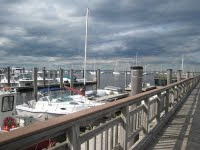
Subscribe to:
Posts (Atom)